

Tyvek / Tyvek® 500 Labo

TYCHF7SWH00

Tyvek® 500 Labo

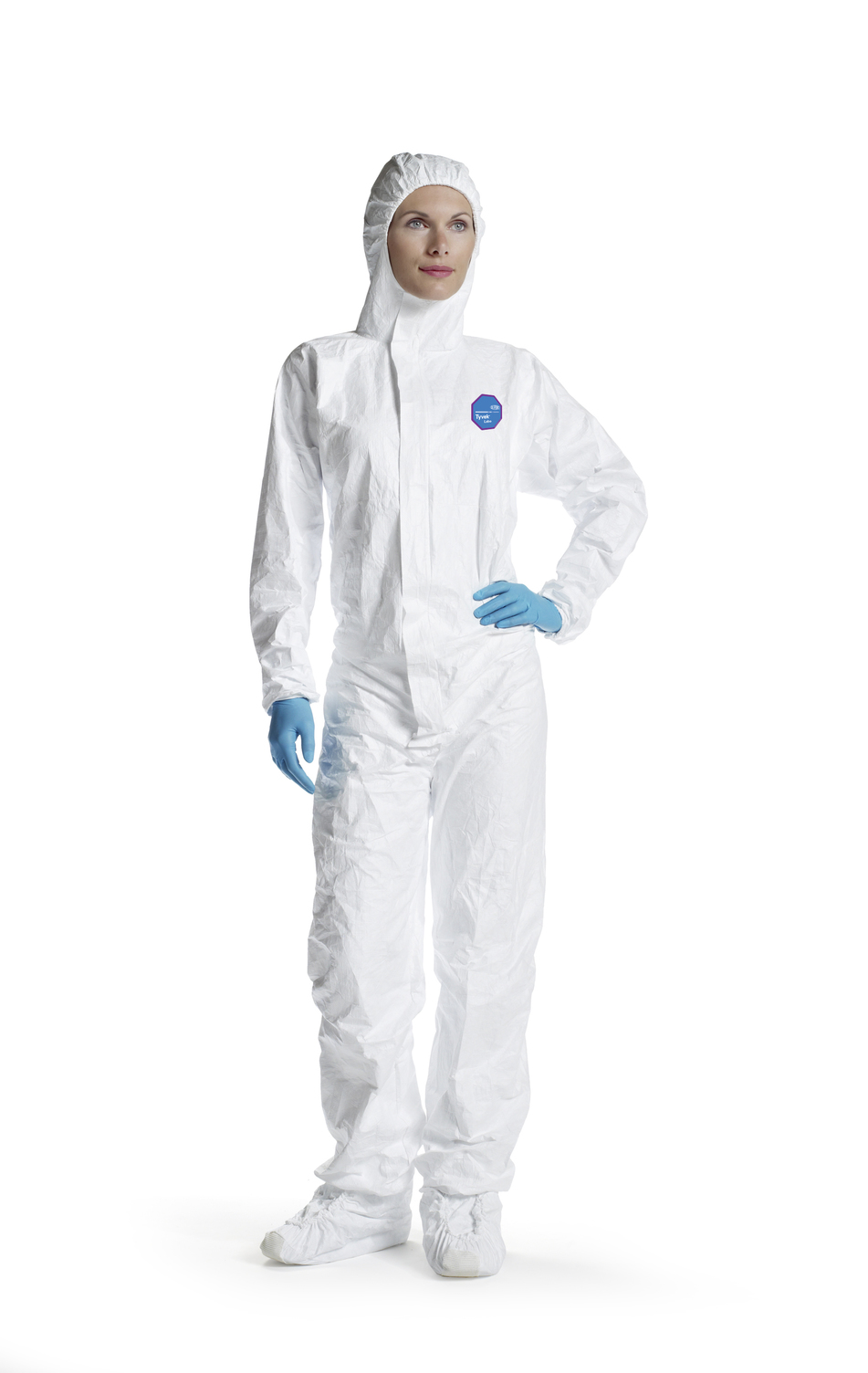
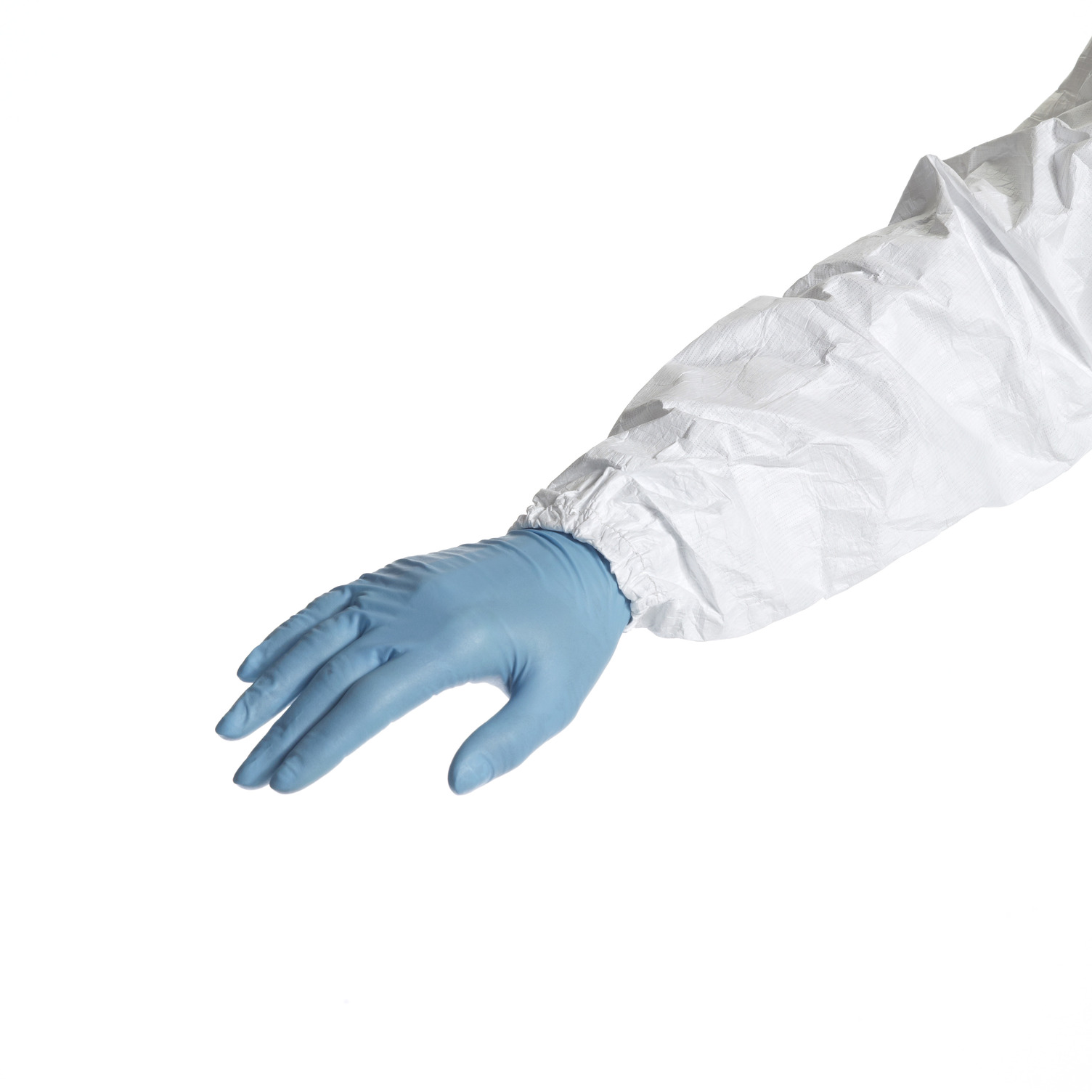
DuPont™ Tyvek® 500 Labo CHF7. Robust yet lightweight protection providing an excellent barrier against fine particles and low-level sprays in a white hooded coverall with overshoes. Features stitched internal seams, a respirator fit three-piece hood, attached slip-retardant overshoes, a gusset, tunnelled elastication at wrists, ankles and face, elasticated waist (glued-in), a Tyvek® zipper with a pin lock slider zipper pull, a storm flap, and thumb loops. Suitable for a variety of applications including pharmaceutical, laboratories, cosmetics, optical, and electronics.


Hover over image to zoom
Standards & Certifications

CAT III

TYPE 5

TYPE 6

EN 1073-2

EN 1149-5

EN 14126

Click For More Details
PRODUCT DETAILS
Full Part Number TYCHF7SWH00
Fabric/Materials Tyvek®
Design Hooded coverall with attached slip-retardant overshoes and elastics
Seam Stitched (internal)
Color White
Sizes SM, MD, LG, XL, 2X, 3X
Quantity/Box 25 per box, individually packed.

Features & Product Details

DuPont™ Tyvek® 500 Labo. Hooded coverall with attached, slip-retardant overshoes. Available in white in sizes SM to 3X. Robust yet lightweight (<250g per garment). 3-piece hood and gusset for improved fit. Elasticated face, wrists and ankles as well as glued-in waist elastic. Thumb loops prevent sleeves from riding up.
Tyvek® garments are composed of flash spun high density polyethylene, providing an ideal balance of protection, durability and comfort. Tyvek® is permeable to both air and water vapour, yet repels water-based liquids and aerosols. It offers an excellent barrier against fine particles and fibres (down to 1 micron in size), is ultra-low-linting and antistatically treated. Silicon non-added.
Applications include the pharmaceutical industry, laboratories, cosmetics, optical and electronics.

  • Certified according to Regulation (EU) 2016/425.
  • Chemical protective clothing, Category III, Type 5 and 6.
  • EN 1073-2 (protection against radioactive contamination)
  • Antistatic treatment (EN 1149-5) - on both sides.
  • Stitched internal seams to help reduce contamination from the inside to the outside of the garment
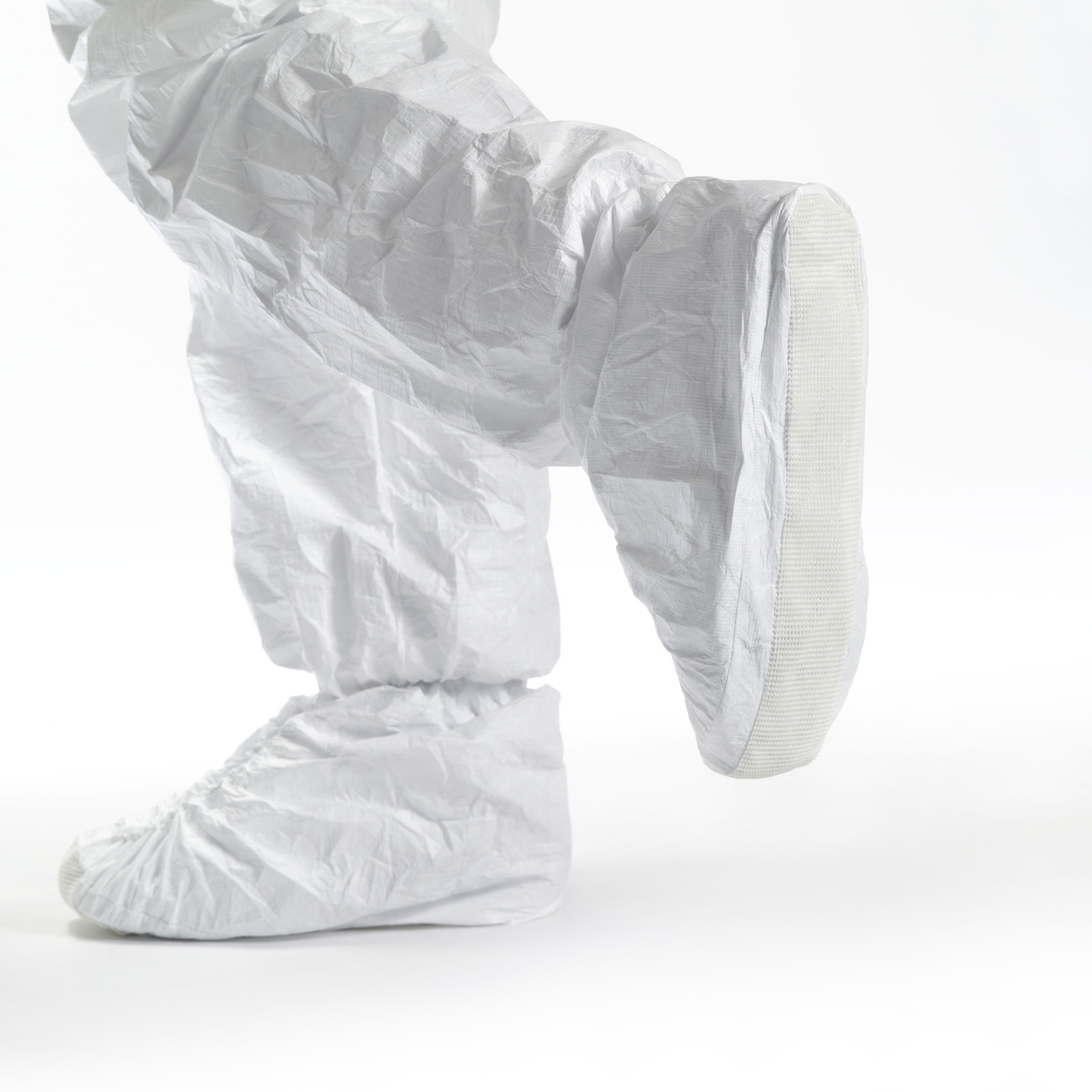
  • Attached overshoes consisting of garment material with friction-coated sole to provide added slip-resistance
  • Suitable for use in GMP class C/D (ISO Class 6-9) clean rooms
  • Protects you and your processes in laboratories and the pharmaceutical industry
  • Extremely high garment production quality control specifications

ADDITIONAL EQUIPMENT NEEDED

SIZES

Fabric & Permeation/Penetration Data

Physical Properties

Data relating to mechanical performance of the fabrics used in DuPont chemical protective clothing, listed for the selected garment according to the test methods and relevant European standard, if applicable. Such properties, including abrasion and flex-cracking resistance, tensile strength and pun

Property Test Method Typical Result EN
Abrasion Resistance 7 EN 530 Method 2 >100 cycles 2/6 1
Basis Weight DIN EN ISO 536 41.5 g/m2 N/A
Colour N/A. White N/A
Exposure to high Temperature N/A. Melting point ~135 °C N/A
Flex Cracking Resistance 7 EN ISO 7854 Method B >100000 cycles 6/6 1
Puncture Resistance EN 863 >10 N 2/6 1
Resistance to water penetration AATCC 127 >10 kPa N/A
Surface Resistance at RH 25%, inside 7 EN 1149-1 < 2,5 • 109 Ohm N/A
Surface Resistance at RH 25%, outside 7 EN 1149-1 < 2,5 • 109 Ohm N/A
Tensile Strength (MD) DIN EN ISO 13934-1 >60 N 2/6 1
Tensile Strength (XD) DIN EN ISO 13934-1 >60 N 2/6 1
Trapezoidal Tear Resistance (MD) EN ISO 9073-4 >10 N 1/6 1
Trapezoidal Tear Resistance (XD) EN ISO 9073-4 >10 N 1/6 1
  •  According to EN 14325
  •  According to EN 14126
  •  According to EN 1073-2
  •  According to EN ISO 14116
  •   According to EN ISO 11612
  •  Front Tyvek ® / Back
  •  Based on test according to ASTM D-572
  •  See Instructions for Use for further information, limitations and warnings
  •  Larger than
  •  Smaller than
  •  Smaller than or equal to
  •  Not Applicable
  •  Standard Deviation

COMFORT

BIOLOGICAL BARRIER

PENETRATION AND REPELLENCY

GARMENT PERFORMANCE

WARNING

PERMEATION DATA

SPECIAL WARNINGS

Frequently Asked Questions

Explore frequently asked questions to help you choose and use DuPont Personal Protection products with confidence.
Marketing How are Tyvek® garments different from other limited-use garments on the market?

Tyvek® garments are unique in several ways. First is the proprietary flash spun Tyvek® fabric which offers inherent breathable barrier that cannot easily be worn or abraded away. This inherent barrier of Tyvek® is not dependent on a thin film or a thin layer of small fibers -- with Tyvek®, every part of the fabric provides barrier. This delivers an effective breathable barrier to particles due to the torturous path created by this unique fabric structure. Unlike microporous film garments, the breathability of Tyvek® garments can be easily demonstrated.

Cleanroom Are the fabric and garment properties are maintained after the sterilization process?

Fabric and garment properties may be affected by the sterilization process. Please verify if the garment is still suitable for for application after the sterilization process.

Fabric For which applications can Tyvek® garments be used?

Tyvek® chemical suits are used to protect people from hazards and processes from contamination by people in a wide range of applications, such as: chemical industry, pharmaceutical industry, automotive, food industry, agrochemical handling, transportation, petrochemical industry, industrial cleaning and maintenance, cleanroom applications, emergency response and military. Tyvek® repels water-based liquids and provides protection against low concentrated inorganic chemicals and particles > 1.0 For further information for which applications the products are suitable, please refer to products and applications.

Permeation The concentration of my hazard is HIGHER than what is listed in the 'Search Hazards' box. What should I do?

If the concentration of your hazard is HIGHER than the hazard concentration listed in the hazard search box, you can NOT use the data for the lower concentration hazard. This data will not give you an accurate assessment of suitable garments. Please Contact Us for assistance.

Permeation What is Penetration and Reppellency and how do you measure it?

Resistance to penetration by liquids is a process in which a chemical moves through pores, seams, apertures or essential openings in a material or finished item of a clothing. Repellency is the ability of a fabric to shed liquid that is applied to the surface of a fabric. Penetration and repellency is measured according to ISO 6530. This test is know a the 'gutter-test'. Reference chemicals for penetration and repellency testing are: 30 % Sulphuric acis, 10 & Sodium Hydroxide, o-Xylene, Butan-1-ol. Chemical protective clothing, Category III, Typ 6 requires a liquid repellency level of 3 for at least one of the four chemicals and a resistance to penetration at a performance level of at least 2 for one of the 4 chemicals. The peformance level for Penetration and Repellency is listed in the Instruction for Use for the specific garment and in SafeSPEC(TM) under Data/Penetration and Repellency. Measuring the resistance to penetration and repellency is a fabric test and only applicable for garments. The test is not required for the Certfication of Partial Body Protection.

Donning & doffing How can I undress safely?

Ideally a second person dressed in a chemical protective suit and other appropriate personal protective equipment provides assistance. To avoid a contamination while undressing the following order is recommended: If the garment is heavily contaminated it recommended to wet it in case of dust or to shower in case of liquid Clean the outer gloves arm parts and zipper area of the garment by using wipes Remove the outer glove while keeping on the inner glove Open the zipper carefully Remove the garment turning it inside out and pull it down to knees. Pull your feet out of the garment carefully Pull the garment together inside out - so the garment can be disposed of If wearing one, remove the mask Remove the inner glove

Permeation How long can a chemical protective suit be worn once contaminated?

It depends on the specific chemical substance, toxicity of the substrate, concentration, fabric barrier performance, garment area contaminated, temperature, pressure of substances when reaching garment surface and protective undergarment. By consulting the permeation data, based on the actual breakthrough time, you can already ascertain whether a constituent fabric offers a barrier for the duration of the task. Where actual breakthrough times are less than the duration of the task, caution is needed.

Permeation Is it possible to measure permeation data for all chemicals?

Permeation measurements can be conducted for liquid and gaseous chemicals for which an analytical methode with a reasonable detection limit is available. Solids can be solved in a solvent. The fabric needs to perform as a barrier to this solvent. The chemical shall not be a risk for the (e.g.

Permeation What is a Cumulative Permeation Time (Time150) mean?

A Cumulative Permeation Time is a time which is required to reach a a total quantity of a chemical per squaremeter. Safespec report the time which is required t acumulate a mass of 150 m time150).

Permeation What does the permeation data tell me about a garment?

The permeation data provides you information on the barrier a protective clothing material offers against a hazardous chemical. Permeation is determined by measuring the breakthrough time and the subsequent permeation rate of the chemical through the material. Permeation rate is defined as the speed at which the hazardous chemical permeates through the test material. Breakthrough time is defined as actual and normalised breakthrough time. The actual breakthrough time is the time elapsed between initial contact of the chemical with the outside surface of the material and the detection of the chemical at the inside surface by the analytical device. An actual breakthrough time of > 480 minutes and a permeation rate of and (not detected) does not mean breakthrough has not occurred. It means that permeation was not detected after an observation time of eight hours. Permeation may have occurred, but at less than the minimum detectable permeation rate. Since actual breakthrough times depend on the sensitivity of the analytical device, the concept of normalised breakthrough times is used. The normalised breakthrough time is defined as the elapsed time between initial contact of the chemical with the outside surface of the material and the time at which the chemical is detected at the inside surface of the material at a permeation rate of 1 cm in (according to EN/ISO 6529, EN 369 or EN 374-3) and 0.1 cm in (according to EN/ISO 6529/ASTM F739). A normalised breakthrough time of > 480 minutes means that the average permeation rate has never reached the defined rate (0.1 min or 1.0 miin) according to the referred norm. However, the chemical may have actually broken through. Attention: The classification of permeation data according to EN ISO 6529 can refer to normalised breakthrough time at 0.1 min or 1.0 min. Therefore, we strongly recommend you verifying at which normalised breakthrough time any performance classification ( e.g. class 1 to 6) is based.

Permeation What is a normalised breakthrough detection time (BT0.1, BT1.0) ? What is an actual breakthrough detection time (BTact) ?

Normalised breakthrough detection time is the elapsed time between the initial contact of the chemical with the outside surface of the fabric and the time at which the chemical is detected at the inside surface of the fabric at a certain permeation rate. The most common normalized detection rates are 0.1 min (BT0.1) and 1.0 min (BT1.0). A normalized detection rate of 0.1 min is used for measurements according to EN ISO 6529 or ASTM F739. A normalized detection rate of 1.0 min is used for measurements according to ISO 6529, EN 369 or EN 374-3. A normalised breakthrough time of > 480 minutes means that the average permeation rate has never reached the defined rate (0.1 min or 1.0 min) according to the referred norm. Actual breakthrough time is the time elapsed between initial contact of the chemical with the outside surface of the fabric and the detection of the chemical at the inside surface by the analytical device (minimum detection permeation rate, MDPR). An actual breakthrough time of > 480 minutes does not mean breakthrough has not occurred. It means that permeation was not detected after an observation of eight hours. Permeation may have occurred, but at a rate less than the minimum detectable permeation rate of the analytical device.

Permeation The temperature of my hazard is LOWER than what is listed in the 'Search hazards' box. What should I do?

If the temperature of your hazard is LOWER than the hazard listed in the hazard search box, go ahead and select the higher temperature hazard as long as the physical phase (solid, liquid or gas/vapor) is the same. Because chemical hazards become more aggressive with increasing temperatures, selecting a higher temperature chemical hazard will lead to a more conservative result. PLEASE NOTE: DuPont garments do not provide adequate insulation to protect the wearer's skin against prolonged exposures to cold temperature hazards. Depending on the temperature of the chemical and the duration of exposure, the wearer could be subjected to frostbite. In addition, at temperatures below -13°F (-25°C), some DuPont fabrics could lose flexibility. Unless otherwise stated, DuPont tests chemical hazards per ASTM F739 at ambient temperatures (approximately 72-81°F ; 22-27°C).

Comfort & Weartime Which underwear is recommended by DuPont?

Generally it is up to the wearer to decide on his/her personal underwear. For higher comfort we recommend the following: wear at least one layer of underwear under the chemical protective suit select underwear with long arms and legs underwear made from traditional fabric such as blended woven structures underwear made from high-performance fibres

Permeation What is a Steady State Permeation Rate (SSPR)?

A Steady State Permeation Rate is a constant permeation rate after reaching an equilibrium. Steady State Permeation Rate is not necessarily reached within the normal test duration of 480 minutes for each chemical-fabric combination.

Cleanroom How can I sterilize a Tyvek® garment

[garment] can be sterilized by using the following methods: In an autoclave: The temperature does not exceed 121. If the temperature is higher than 121 the material will shrink too much. At 121 the garment will shrink for about one size. Tyvek® 500 melts at 135 and a temperature near this has to be avoided. Irradiate with beta- or gamma- rays: An irradiation dose lower than 25 kilogray won't damage the mechanical properties of Tyvek® 500. This dose should not be exceeded. Treatment with Ethylene Oxide gas. Due to the toxicity of Ethylene Oxide, please take care of a good out-gazing of the garments. Most sterile Tyvek(r) coveralls are sterilised typically by gamma irradiation. Please be informed that physical properties of the material and the barrier performance may change and that you have to ensure yourself that the sterilization process has been successful and that the sterilized product is suitable for your application.

Permeation What is Permeation and how do you measure it?

Permeation is the process by which a potentially hazardous chemical moves through a material on a molecular level. This process involves the following steps: 1. Sorption of molecules of liquid onto the contracted (outside) surface of the fabric. 2. Diffusion of the sorbed molecules across the fabric. 3. Desorption of the molecules from the opposite (inside) surface of the fabric. Permeation measurements are conducted to the following norms EN ISO 6529 (method A and B), ASTM F-739 or EN 374-3. For these methods a two-chambered test cell is used. The test specimen is positioned between the two sections of the cell. On the challenge side of the test cell the outside fabric surface is exposed continuously to the challenge chemical. The sampling side of the test cell is analytically monitored. The standard test duration is 480 minutes. Permeation measurements are conducted at room temperature and at at ambiant pressure (if not stated otherwise). EN ISO 6529 Methode A describes measurements o liquid chemicals with continous contact. EN ISO 6529 Methode B describes measurements of gaseous chemicals with continuous contact. The rest result of a peremation measurement is reported as a breakthrough time in minutes at a normalized permeation rate (BT0.1, BT1.0) or as a Class according to EN 14325. testing solid chemicals,

Permeation The temperature of my hazard is HIGHER than what is listed in the 'Search Hazards' box. What should I do?

If the temperature of your hazard is HIGHER than the hazard listed in the hazard search box, you can NOT use the data for the lower temperature hazard. Chemical hazards become more aggressive with increasing temperatures. Selecting a lower temperature chemical hazard will not give you an accurate assessment of suitable garments. PLEASE NOTE: DuPont garments do not provide adequate insulation to protect the wearer's skin against prolonged exposures to high temperature chemical hazards. Depending on the temperature of the chemical hazard and the duration of exposure, the wearer could be subjected to a thermal burn. Unless otherwise stated, DuPont tests chemical hazards per ASTM F739 at ambient temperatures (approximately 72-81°F ; 22-27°C).

Antistatic How can Tyvek® 500 garments be correctly grounded?

In general, garments must be correctly and continuously grounded by contact with electrostatic dissipative shoes, floor and/or grounding cable to the antistatic treated side of the garment. If the wearer of an antistatically treated garment is not connected to a grounded surface, the wearer/garment will remain charged. It also important to consider that electrostatic charges may also build up on ancillary equipment such as breathing apparatus and other devices. Therefore those must be separately grounded when worn in conjunction with a garment. Attention must be paid to the local humidity levels since in dry environments with a relative humidity below 25%, the antistatic finish may no longer function effectively. Garments with attached socks cannot be grounded via the shoes.

Permeation I have a chemical mixture, what guidance can you give me?

Permeation tests, by comparison, are better suited for testing hazardous liquids and vapors. It is the test method of choice for Tychem® fabrics. There are many critical factors that influence permeation: the challenge chemical (i.e. concentration, temperature, surface tension, the size of the molecules, functional groups, etc.), the make-up of the barrier material, the exposure time and several physical factors like ambient temperature and pressure, just to name a few. Because there are so many variables, DuPont has performed permeation tests on hundreds of chemicals against our Tychem® fabrics.

Permeation What is the difference between EN ISO 6529 (method A and B), ASTM F-739, EN 369 or EN 374-3.

Permeation measurements acc. to EN ISO 6529 (method A and B) can be reported at a normalized permeation rate at 0.1 min and/or 1.0 min. Measurements are conducted at 23. Permeation measurements acc. to ASTM F-739 are reported at a normalized permeation rate at 0.1 min. Measurements are conducted at 27.This norm is mainly used in the USA. Permeation measurements acc. to EN 374-3 are reported at a normalized permeation rate at 1.0 min. Measurement is conducted at 23. This norm is mainly used in the glove industry. EN 369 has been supersedes by EN ISO 6529:2001. Measurement which have been conducted to these norms are comparable due the use of normalized breakthrough detection times.

Permeation What is a Minimum Detection Permeation Rate (MDPR)?

A Minimum Detection Permeation Rate (MDPR) is the lowest measurable rate for a measurement system, The MDPR can vary depending on the sensivity of the analytical device for a given test chemical.

Permeation What is the difference between Penetration and Pemeation?

In terms of chemical protective clothing, penetration is the passage of a chemical through a pore or opening in the barrier material. Permeation is the absorption, diffusion and desorption of a chemical through the barrier material at the molecular level.

Comfort & Weartime In what ways can I manage or prevent heat stress?

Chemical protective clothing can interfere with the natural regulation of body temperature. This can lead to a rise in core body temperature and heat stress. Implementing a conservative work/rest schedule or using a cooling system like the DuPont™ Cool-Guard® vest may be effective in reducing heat stress. (Note: Do not wear cooling vests in potentially flammable or explosive environments.) Be aware of the symptoms and treatment of heat stress. If you or your co-workers have symptoms of heat stress such as nausea, dizziness, high heart rates, or excessive heat build-up, leave the work area immediately and remove the ensemble as quickly as possible after decontamination and seek professional care. The maximum length of time the chemical protective clothing can be worn depends on variables such as the air supply, ambient conditions, climate inside the ensemble, physical and psychological conditions of the wearer, work rate and work load. The TLV® pocket guide from the American Conference of Governmental Industrial Hygienists (ACGIH, Cincinnati) provides corrected heat stress limits for some garments. Similar information is available on the federal OSHA web site (www.OSHA.gov). The WBGT correction factor for chemical protective garments is at least 10°C or higher for chemical garments made of impervious films (such as Tychem® garments) and covering the entire body (hooded coverall or encapsulating designs). For Tyvek® coveralls, the WBGT correction factor is 2°C with a hood and 1°C without a hood.

Garment Selection Whose responsibility is it to select the appropriate chemical protective clothing?

In the USA, OSHA 29CFR1910.132 states that it is the responsibility of the employer to:

  • Perform a hazard assessment
  • Select PPE and inform employees
  • Fit and train employees on use, care and service life of PPE

Garment Selection How shall I proceed when selecting chemical protective suits?

When selecting protective clothing, DuPont recommends taking four steps to ensure an appropriate selection and successful implementation. Those steps are: 1. Risk assessment: Before searching for protective clothing, it is recommended to do a detailed assessment of the nature of the hazard, the type of exposure and the working environment. 2. Defining the appropriate garment type: Once a risk assessment has been made the appropriate garment type can be defined. 3. Research: Since there a variety of limited-use protective clothing available in the market one should consider certain performance criteria for the garment selection process, such as for example, protection, durability, comfort, quality, compatibility with other personal Protective equipment, environmental compatibility and value for money. Information on type certification, barrier performance and fabric physical properties can be gained from the use instructions supplied by the manufacturer while information on other properties, for example, user friendliness, protection performance in real applications amongst others can only be gained in a wear trial. 4. Testing for success: After having selected a Tyvek® chemical suit matching the analysed requirements it is recommended to carry out a wear trial under real working conditions to gain feedback from the employees. Furthermore, the employees feel integrated in the garment choice which may result in less acceptance problems when implementing the selected garment.

Donning & doffing What the correct way to dress?

A proper dressing is a must for proper protection. There are a couple of steps to be considered : Check if the place of dressing is contaminant free Check the garment, check if type and size are appropriate, if the zipper is working and if the clothing material and seams are defect free Check compatibility of other Personal Protective Equipment (PPE) with protective suit selected as well as their functionality Decide whether normal working clothing or special underwear shall be worn under the garment Take off your shoesFirst enter the garment with your feet then the arms and pull it over your back Close the zipper up to chest high Put on safety boots Pull the garment leg over the boot If a mask is required for the considered task one shall put it on at this stage following the instructions given by the mask manufacturer Once the mask is put on, the hood is put on making sure that it fits tightly to the mask. Ideally a second person controls the tightness around the mask. If no second person is available it recommended to do the check with a mirror. Close the zipper as far as possible and make sure that the zipper flap covers the entire zipper. Put on the gloves (ideally inner and outer glove), if only one glove is used put the gauntlets below the sleeves. For additional protection the hood can be taped to the mask and the gloves to the sleeves. Furthermore it is recommended to tape the zipper flap.

Permeation What does a permeation class acc. to EN 14325 (EN) tell me?

The permeation resistance of a fabric is classified according to EN 14325 into 6 level of performance (classes) based on the time which is required to reach a normalized breakthrough time of 1.0 min (BT0.1) when tested according to EN 374-3 or ISO 6529. Class 6 is reached when the BT 1.0 is larger than 480 minutes. Class 5 is reached when the BT 1.0 is larger than 240 minutes. Class 4 is reached when the BT 1.0 is larger than 120 minutes. Class 3 is reached when the BT 1.0 is larger than 60 minutes. Class 2 is reached when the BT 1.0 is larger than 30 minutes. Class 1 is reached when the BT 1.0 is larger than 10 minutes. This classification can simplify the Use of Permeation data.

Antistatic What is to be considered when working in explosive environments?

When working in explosive environments it is recommended to first control the relative humidity since in extremely dry environments with a relative humidity below 25%, the antistatic finish on the garments may no longer function. The chemical protective suit must be correctly and continuously grounded via electrostatic dissipative shoes, floor and / or grounding cable. If the wearer of an antistatically treated garment is not connected to a grounded surface, the wearer/garment might remain charged.

Antistatic Are Tyvek® garments antistatically treated?

Tyvek® chemical suits manufactured by DuPont have an antistatic treatment on both sides. Garments manufactured from coloured Tyvek® and Tyvek® 800 have an antistatic treatment on the (white) inside surface only. Tyvek® 800 and white and coloured Tyvek® garments meet the surface resistivity requirements of EN 1149-1. Below 25% relative humidity of air the antistat may lose its dissipative properties.

Comfort & Weartime Why is the size of the garment I� wearing so important?

The size of the chemical protective suit selected is very important since proper fit is part of proper protection. Furthermore, a good fit ensures a protective suit is comfortable and avoids extra heat up which can be caused by too big suits. By poorly fitting garments either too small or too large you have an increased risk of tearing the garment and of being restricted in your movements or getting caught in machinery, which can adversely affect your ability to carry out your work safely.

Comfort & Weartime What is the ambient working temperature range for Tyvek® 500 garments?

Tychem® garments can be worn in ambient temperatures of -13°F (-25°C) to 120°F (49°C).
In colder environments, Tychem® garments can become stiff. If cold enough, the fabric may even become brittle. Please be aware that the heat stress of the wearer becomes a greater concern in higher ambient temperatures. At higher temperatures, chemical hazards can become more aggressive. Breakthrough times and permeation rates may change at higher temperatures. The published permeation data per ASTM F739 is performed at ambient temperatures (approximately 72-81° F ; 22-27° C). Caution: Tychem® fabrics offer little or no thermal insulation to protect the wearer's skin from prolonged exposure to hot or cold.

Fabric What is Tyvek®?

Tyvek® is the brand for a protective material and protective clothing manufactured from it. Tyvek® is a versatile non-woven material manufactured only by DuPont. The unique combination of properties of Tyvek® makes it very suitable for a number of end use applications, for example Protective Apparel amongst others. Tyvek® is made of millions of ultra-fine, continuous fibres of high-density polyethylene that are flash spun and heat-bonded into a fabric. It is permeable to air and water vapour, repels water-based liquids and aerosols, blocks particles and fibres down to 1 plus its low linting and free of paint-damaging-compounds. These key properties make Tyvek® the first choice for the manufacturing of limited-use Tyvek® chemical suits and protective clothing.

Permeation Are permeation data for warefare agents peformed in the same way than for industrial chemicals.

Warefare agents are tested according to MIL_STD_282 at 22r according to FINABEL 0.7 at 37. Due to the anaytical methods which is used in these standards the result of the measurements are proported at actual breakthrough times only.

Antistatic What are typical mistakes when working in protective clothing?

The following typical mistakes that can happen when working with protective clothing have been reported to us: Opening of garment or mask while working in the risk zone. Interrupting the task and leaving the dangerous zone with contaminated garment and moving to other zones like offices. Carelessness of wearers with regard to hot surfaces, sparks or sharp edges. Employees with a passive role in the dangerous zone do often not wear protective clothing. No or false grounding of garments due to insufficient knowledge or underestimation of risk of electrostatic charging. Under protection: wrong fabric selection or garment tightness level for the hazard. Loss of protection if the suit becomes abraded or damaged and is not changed.

Permeation The concentration of my hazard is

LOWER than what is listed in the 'Search Hazards' box. What should I do?

If the temperature of your hazard is LOWER than the hazard listed in the hazard search box, go ahead and select the higher temperature hazard as long as the physical phase (solid, liquid or gas/vapor) is the same. Because chemical hazards become more aggressive with increasing temperatures, selecting a higher temperature chemical hazard will lead to a more conservative result.

PLEASE NOTE: DuPont garments do not provide adequate insulation to protect the wearer's skin against prolonged exposures to cold temperature hazards. Depending on the temperature of the chemical and the duration of exposure, the wearer could be subjected to frostbite. In addition, at temperatures below -13°F (-25°C), some DuPont fabrics could lose flexibility.

Unless otherwise stated, DuPont tests chemical hazards per ASTM F739 at ambient temperatures (approximately 72-81°F ; 22-27°C).

Permeation What does Cumulative Permeation Mass (CUM480) mean?

A Cumulative Permeation Mass is the total amount (mass) of chemical that permeates the fabrics during a certain time.